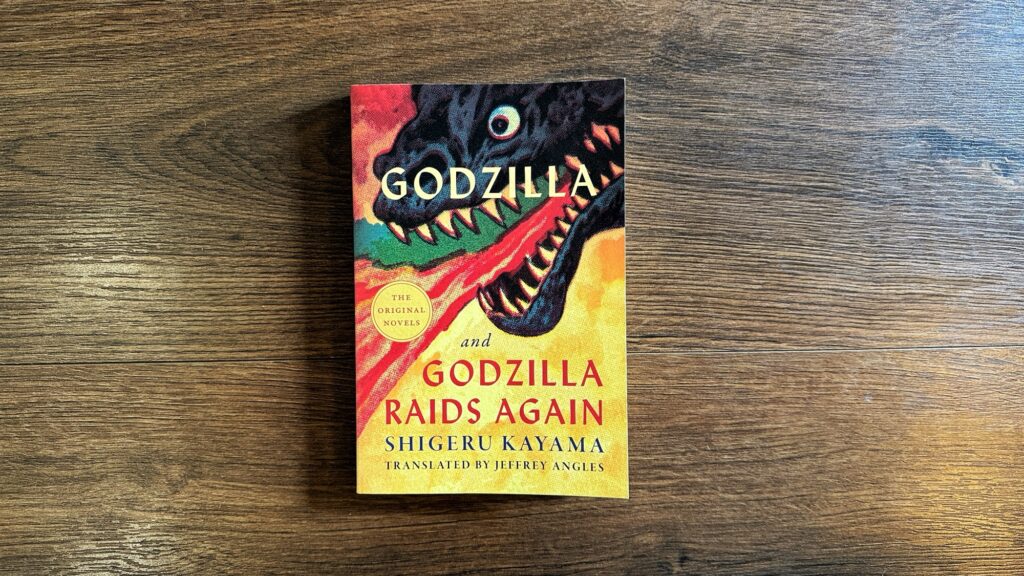
READ IT: GODZILLA and GODZILLA RAIDS AGAIN

Read the (somehow) very first English translation of the first two Godzilla novels, GODZILLA and GODZILLA RAIDS AGAIN. Originally written in 1954 by Shigeru Kayama who was also one of the original films’ creators. The novelizations came immediately after the films we shown in an effort to further capitalize on their massive success.

As such they read a lot like one might describe the films as they play out on screen. There is very little in the way of additional character development or lore. It’s mostly: People in a boat are having a good time. Godzilla shows up. People freak out. Godzilla smashes some stuff. Bang! Zoom! Crunch! And goes away. People worry about him coming back and what they can do to stop him. Godzilla comes back and messes more stuff up. Whoosh! Zoom! Kablammo! Now the people really need to do something and say so over and over until a very unlikely solution suddenly appears and Godzilla is defeated, the end, we will not be taking any further questions.

Sure, there is a bit more depth than that, but if you’re going into these books in the hopes of really getting to know the “why” and “how” of Godzilla, you won’t find it much beyond “bombs did it.” Which is fair.

As far as I can tell the translation is great, and in fact translator Jeffery Angles’ afterword commentary was the highlight for me. He goes over a bit of Kayama’s early history, the making of the films, the writing of the books, and Kayama’s own feelings about Godzilla’s success overall. Considering that Kayama doesn’t have his own Wikipedia entry (in fact the entry for this book has far more info about him than you can easily find elsewhere) this might be the only place to find this information in English.

Side note: This was published by the University of Minnesota Press who also published the nearly award winning cookbook I had a part in bringing to life.

(Opening page. An example of understatement.)
Read It: DEAD WEIGHT

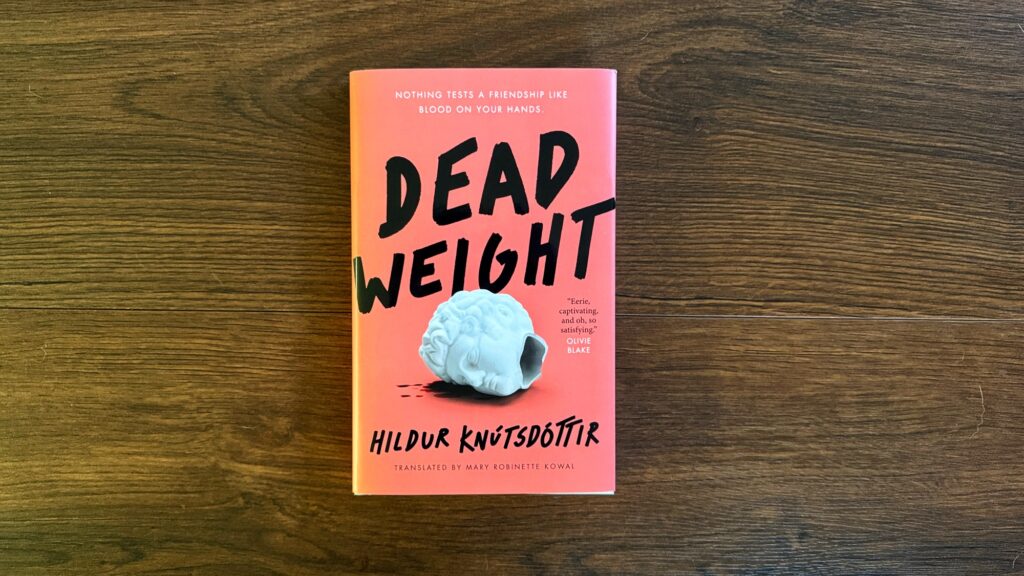
Read the latest novella from Icelandic author Hildur Knútsdóttir, DEAD WEIGHT.

Her previous novel (and first to be translated into English) THE NIGHT GUEST was a tightly focused story of a woman who suspects that her body is living its own life while she sleeps (being as vague as possible here.) DEAD WEIGHT is again narrowly focused (complimentary) on how a woman gets drawn into something increasingly dark both against her will and also because of her own ambitions and obsessions. Both stories are efficiently written and accelerate at a steady pace that makes them hard to put down. I’m reminded of Stephen King’s Bachman Books where King finds a pressure point and just keeps on pressing it until something breaks in a spectacularly bloody fashion.

The translation by Mary Robinette Kowal is crystal clear and proves that Knútsdóttir can be just as funny as she is ruthless.

It is already set to be a feature film by Act4 and Skogland Films.

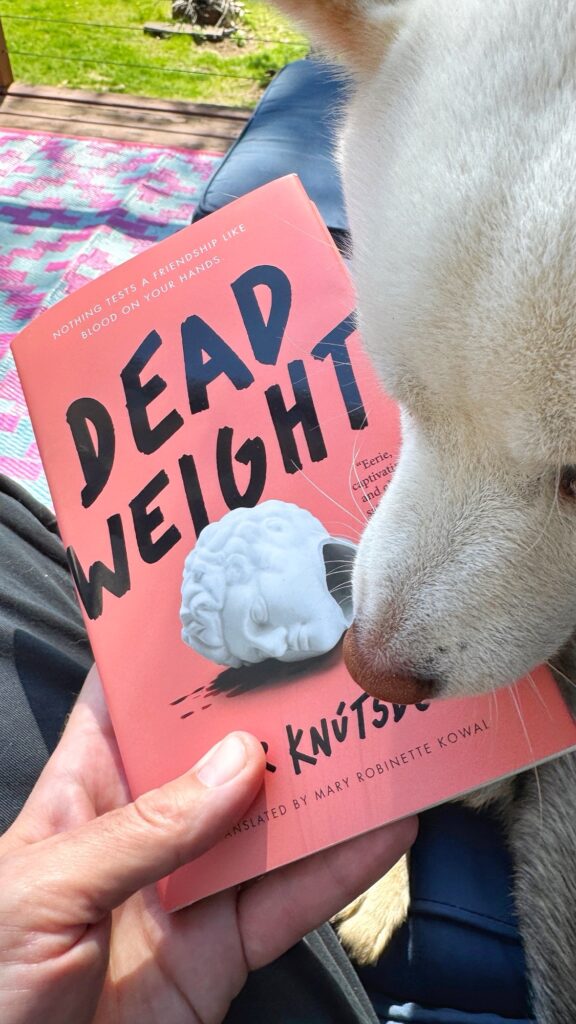
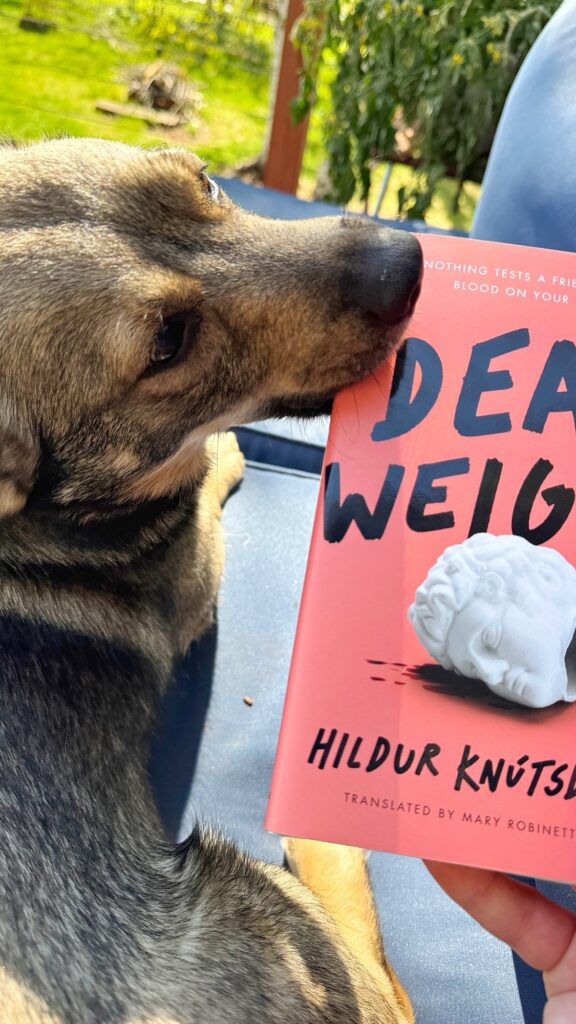
(Both Vigi and Fumi show their good taste. Follow Knútsdóttir on Bluesky to understand what this is all about.)

Read It: ROADSIDE PICNIC

Read the 2012 Olena Bormashenko translation of the 1972 novel Roadside Picnic by the Russian brothers Arkady and Boris Strugatsky which was made into the 1979 film Stalker, directed by Andrei Tarkovsky, which I first saw, oh let’s say in the 2010-2017 range. A circuitous route to be sure. If you, like me, only knew the story via the film then you, like me, were largely ignorant of what the book contained until you, like me, finally got around to reading it. The film is mostly a faint echo of the events of the book which has me wanting to watch the (grim) film again because I couldn’t remember anything in the book happening in the film other than some very basic details. As far as I’m concerned, its greatest contribution is this image/vibe:

a man laying down on a very small strip of grass surrounded by water, while a black shepherd-like dog looks at him

A simple distillation of the plot is: Aliens visit Earth and then leave. They leave behind both physical objects and less tangible “zones” that have strange effects on humanity and the environment. People go after these objects and die or get grievously injured (physically/mentally) in the process. Mostly they talk about it a lot. Highly recommended.

The song that was playing as I read the final scene and which was the perfect accompaniment was this one from Ian William Craig and Daniel Lentz titled “Stöltzle.” Also highly recommended.